The discovery prompted administrative action against the facility, with reports showing a fine of 839,122 Turkish lira imposed under the country's Environmental Law.
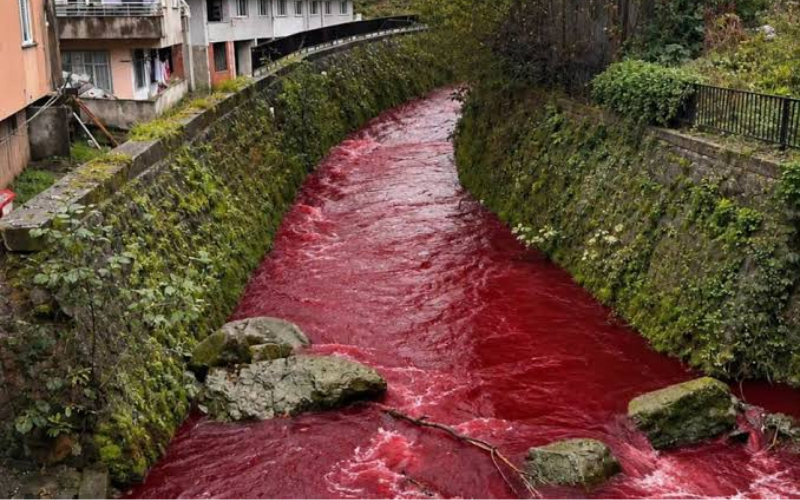
A stream in northeastern Türkiye has turned a striking shade of red, prompting environmental investigations after residents raised concerns over possible pollution.
The unusual discolouration was reported on November 21, 2026, along the Değirmendere Stream in Rize Province, where residents and passers-by were stunned to see water flowing through the channel in a vivid crimson colour.
Footage of the stream quickly spread across social media, with its blood-like appearance prompting speculation about the possible cause and concerns over the impact on aquatic life and the surrounding environment.
However, authorities have found no evidence that the water contained blood, with initial investigations instead pointing to a suspected uncontrolled wastewater discharge from a nearby facility.
According to local reports, environmental inspection teams from the Provincial Directorate of Environment, Urbanisation and Climate Change, alongside municipal enforcement officers, moved to establish the source of the discolouration.
The discovery prompted administrative action against the facility, with reports indicating that a fine of 839,122 Turkish lira was imposed under the country's Environmental Law.
Authorities also collected water samples for laboratory analysis to identify the substances responsible for the unusual colour and establish the extent of possible contamination.
Despite identifying a suspected source, the exact chemical composition of the discharge remains unclear. Officials are yet to establish whether the substances released into the stream pose a wider environmental threat.
Değirmendere Stream runs through Rize city centre before emptying into the Black Sea, raising concerns about the possible effects of the discharge beyond the immediate area.
The laboratory findings are expected to provide further clarity on the substances responsible for the dramatic discolouration and whether the incident poses a broader environmental risk.