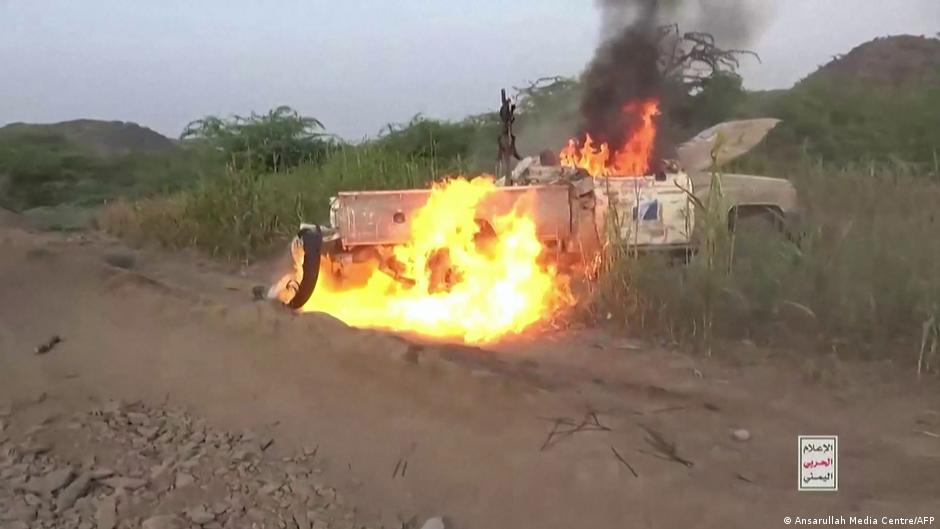
Saudi Arabia faces growing security and economic problems as it seeks to balance deterrence and diplomacy amid an escalating conflict with the Iran-backed Houthis in neighboring Yemen.
Houthi attacks on Saudi Arabia injured another 13 people on Monday night bringing the total number of people injured since the conflict escalated in July to about 100.
In July, the Houthis also blocked Saudi oil shipping in the Bab el-Mandeb Strait, a key waterway that had been serving as an alternative route for Saudi oil exports amid Iran's blockade of the nearby Strait of Hormuz.
Last week, Saudi Arabia's alternative lifeline for oil export, the East-West pipeline, was allegedly targeted by Iranian proxy militias in Iraq. On Tuesday, officials said that it might take weeks to repair the damage to the pipeline which runs 1,200 kilometers (745 miles) across the country and ends at the port of Yanbu on the Red Sea.
"Riyadh faces a genuine dilemma," Neil Quilliam, associate fellow of the Middle East and North Africa program at the London-based think tank Chatham House, told DW. "The Saudi Crown Prince Mohammed bin Salman is trying to protect both Saudi security and Saudi economic development simultaneously," he said. "The difficulty is that the Houthis are increasingly able to threaten both."
Saudi Arabia has one of the most heavily armed and technologically sophisticated militaries in the Middle East, especially in combat aviation and air defense.
But the country is "reluctant to become drawn back into a costly military campaign in Yemen," Quilliam said.
A Saudi-led military coalition intervened in Yemen in 2015 to support the government's fight against Houthi insurgents. After seven years of intense war between the Houthis and the Saudi-backed government, the fighting eased in 2022 with a UN-brokered truce.
The latest Houthi attacks on Saudi Arabia and the Saudi-backed government in Yemen aim to pressure Saudi Arabia to end its air and sea blockades on Houthi-held territory which have not been fully lifted despite the 2022 truce.
"Saudi Arabia is now in a very complicated situation," Sebastian Sons, Middle East observer at the German Middle East Research Center CARPO, said.
"On the one hand, it needs to make it clear to the Houthis that a red line has been crossed and that there must also be a military response, particularly in coordination with Yemen's internationally recognized government.
"But on the other hand, it also needs to keep the lines of communication open in order to get back to the negotiating table and to de-escalate the situation."
In his view, Riyadh's goal is to balance deterrence and diplomacy. "The argument is very clear," he said, adding that "the Houthis are not only a threat to Saudi Arabia but to the global economy as a whole."
After Houthi advances in southern Yemen last week, including the seizure of port cities and Perim Island in the Bab el-Mandeb Strait, the rebels are now able to exert even more pressure on global oil supply.
This strategy could lend more leverage to Iran in its war with the United States. According to the maritime data and analytics firm Kpler, only 21 commodity vessels transited the Bab el-Mandeb Strait on Monday. Before the crisis, the narrow waterway handled roughly 30% of global container traffic.


