Russia’s aggression, Trump’s threats against Greenland and the race for critical raw materials are pushing the Arctic to the top of Europe’s agenda.
"There is a high demand for concrete EU action in the Arctic," Orpo said. "Our security environment has changed fundamentally. The Arctic has emerged as a central arena of great power competition."
The changing security environment was a central theme throughout the summit. EU foreign policy chief Kaja Kallas warned that Russia is reopening former Soviet military bases in the region and conducting missile exercises in the High North.
"We also see that China is increasingly more interested in the region, so we have to remain vigilant," Kallas said.
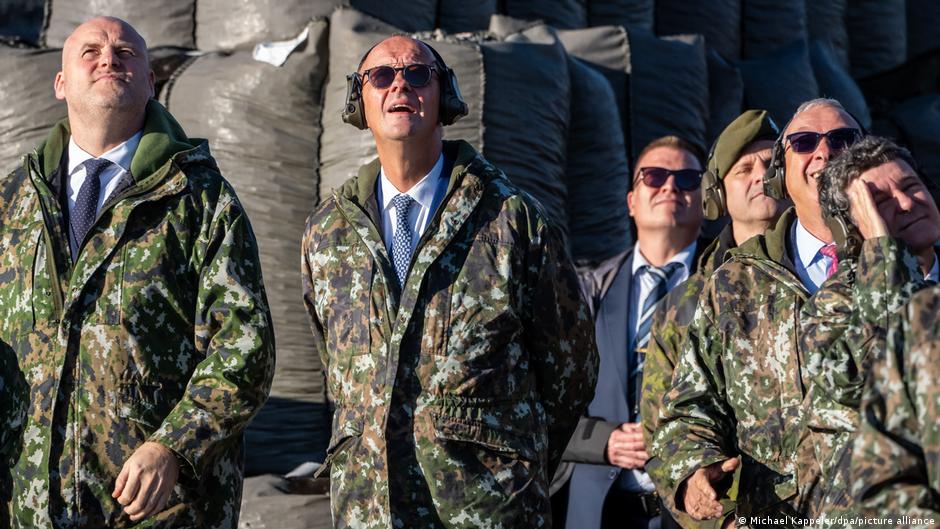
The leaders gathered at Finland's northernmost air force base, looking up into a cloudless blue sky as Finnish fighter jets took to the air for a demonstration. Security has been placed at the heart of the discussions by Prime Minister Orpo. From Rovaniemi, Finland's Air Force monitors the skies along Europe's Arctic border with Russia ― 24/7.
German Chancellor Friedrich Merz, who attended despite facing significant political pressure at home, described the region as increasingly important to Europe's security: "This region has become a geopolitical hotspot. Russia is building up its military capabilities here and… uses its presence for hybrid activities every day."
Merz added that the Arctic is not only a security issue, but also offers major economic opportunities, particularly when it comes to critical raw materials.
"From the Putin era onwards, Russia has been developing its military capacities everywhere, but also in the Arctic," said Timo Koivurova of the Arctic Centre at the University of Lapland.
For years Western countries still continued cooperating with Moscow on scientific research and climate issues. Russia's full-scale invasion of Ukraine brought that era to an end. Finland and Sweden joined NATO as a direct consequence of the war. Finland's 1,340-kilometer border with Russia is now also a NATO border, fundamentally changing the security landscape in northern Europe.
The European Commission plans to update its 2021 Arctic Strategy as early as October 2026. The summit's joint declaration calls for greater investment in military mobility, cross-border connectivity and critical infrastructure in the EU's northernmost regions, including transport links, digital networks and satellite technologies.
Koivurova said that Russia's current focus on Ukraine and that war takes its military capacities.
"But obviously when that war is over, and someday it will be over, there will be a lot of investments from Russia, very likely also in the northern regions, because they are so important for its overall security," Koivurova told DW.
The Arctic is also being affected by tensions among Western partners, Koivurova said. In particular, he argued that US President Donald Trump's proposals regarding Canada and Greenland have strained cooperation among Arctic allies.
"Trump's proposal to have Canada as the 51st state of the United States, or the purchase of Greenland, these are really major problems for the cooperative relations between the western Arctic states," Koivurova said. "That is a kind of additional stress factor for Arctic governance cooperation."
"In my opinion, [the] Arctic is now slowly dividing into three parts," Heikkilä told DW.